Showing posts with label Buddhism. Show all posts

Tuesday, May 22, 2012

Theravada Buddhism vs Mahayana Buddhism


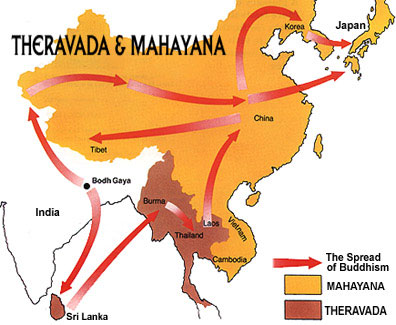
This is a map of Asia. It shows where Mahayana and Theravada are taught.
Available at: http://goo.gl/YiVu5


Today, we will be looking at two different types of Buddhism; Theravada and Mahayana Buddhism. During this post I will  compare and contrast the two.

If you only know of Buddhism as a whole, there are different types. Theravada and Mahayana are two different types of Buddhism. To start off here is a little background info on each type.

Theravada Buddhism

This type of buddhism is more in the southern region of Asia. Their main goal is through meditation, in which, they would train your mind and encourage freedom of suffering through meditation. This type of buddhism also originated a language known as Pali. Which is known as “the Doctrine of the Elders”. This type of buddhism is probably the oldest and has one of the oldest remaining schools of Buddhism.

Mahayana Buddhism

This type of buddhism lies in the eastern part of Asia. This type of buddhism only teaches from the Tripitakas, they’re religious text in Theravada buddhism. Mahayana Buddhism believes that a person has to practice universal compassion in order to attain the “Awakened mind” of Buddhism.

After your brief intro on Theravada and Mahayana Buddhism, I will discuss their differences and similarities.

Between these two the differences are in great number. In general, what they teach about Buddhism is different.

Theravada schools are very strict, plain, and orthodox. They are one of the oldest schools and they teach the old way. There is only one school left like this that teaches the Theravada way.  Mahayana schools are quite different, they have variety and are everywhere.

The scriptures that Theravada uses the Pali Canon and Tripitakas only while Mahayana uses those plus other sutras.  Also, the Buddha that they use are different. Theravada use the original buddha Gautama only, while Mahayana uses Gautama, Amitabha, and medicine buddhas.

The language that their teachings are taught are very different, Theravada only teaches in Pali. On the other hand with Mahayana their teachings are translated into local languages.

Even though these two seem very different, a lot of their difference surfaces similarity in some kind of way. For example, one only uses Gautama while the other uses Gautama plus more. Therefore, they are different but similar.

Speaking of similar, these two types of buddhism are alike in the matter of that they both use the Four Noble Truths, the Eightfold Path, and reject the idea that a supreme being created and governs the world. There isnt many similarities, but  they aren’t completely different.

Theravada and Mahayana Buddhism are highly different in the way they teach from how they teach, what they teach, and where they teach, but despite the differences they are surprisingly similar to certain aspects.

Thursday, May 10, 2012

Interview with a aspiring Buddhist.


Okay readers, it’s time for an interview!  


This post I will be interviewing Chase M (his picture is to the right), he is a very good friend of mine who is currently a novice venturing into the life and philosophy of Buddhism. He is quite the character and should have no problem answering any question I can throw at him.

Let’s begin!


Who or what specifically brought you into the interest of Buddhism?

I was online searching a few random things and I stumbled upon an article about the teachings of Buddha. They really interested me and I wanted to know more.

Do you see Buddhism more as a set religion or a form of philosophy?


I see Buddhism as a form of philosophy. It is a way of life for many people and the morals or concepts can help you with your daily life.

What all do you want to take from Buddhism in experience?


Uhm, I hope to seek a better knowledge of the world and people around me and fully reach that final state of Nirvana.

Have you ever tried using Buddhist philosophy in your daily life?


Yes, I do. I take some of the five precepts and apply them every day. I take awareness of my thoughts and feelings constantly.

What do you think about the concept of karma?


I believe that everything happens for a purpose. I also believe that however you treat other will depend on how you, yourself, will be treated in this life or a next life.

Have you ever sat down and meditated? If so, how did you feel afterwards?


Yes, I have. I felt so much better. If I had a bad day at school I will go home and meditate and all the stressors of the day will be completely eliminated.

Would you recommend Buddhism to others? Why?


I wouldn't because I don’t believe any religion or type of philosophy should be influenced on other. I think it should be their own choice who they follow or believe.

Do you know anyone besides myself who is into Buddhism or its philosophy?


No, not exactly but I would like to find more people with the same interest and ideas.

That concludes my interview with Chase M. He successfully answered all of my questions to his fullest capability. I would like to say thank you to him for his time and effort in this post and thank you 
for reading!


This song I found to be really interesting to listen to. 

If it is blocked, click here for the link.


****** I apologize for the formatting. It is a bit messed up. I have tried fixing it all morning and nothing is changing. So, I'm sorry.******

Friday, May 4, 2012

Buddhism for beginners: What is it?


The 'Dharmachakra.
Available at: http://goo.gl/5rNl2


This post if for the beginners. I’ve covered who Siddhartha Gautama is, now you need to know the rest or else you’ll go now where in your practice. After reading A Basic Buddhism Guide: 5 Minutes Introduction, I had found these helpful facts and questions for you beginners.

To start you off: Is Buddha a God?

No, he is not. He does not claim to be a God or take the title of one either. Buddha was a religious man who went through the path of enlightenment and wanted to teach it to others. Many of his followers do not look to him as a God to pray to or to ask for favors. They look to him to remind them to reach for peace and love within themselves and others. Bowing to his statue is a sign of gratefulness to his teachings and paying respects to images of him as well is a way they show their gratitude towards Buddha.

Is Buddhism a religion?

Yes and no. To many people Buddhism is more of a way life or philosophy than a religion such as Christianity.

Is there different types of Buddhism?

Yes! There is many different types of Buddhism. It differs on which country you look at or are in. But yes, there is many types and all are the same considering they all teach the Dhamma or the truth.

Are all the other religions wrong?

As taught by Buddha, his teachings require you to be tolerant to all religions and cultures no matter what it is. Real Buddhism is highly tolerant and does not use labels to signify what you are. As saying this, there has not been many wars concerning Buddhism. Buddhist in general will not try to convert or preach your head off like its the Inquisition.

What does Buddha teach?

Buddha teaches a variety of things. The most common and basic teachings is of the Four Noble Truths and Noble Eightfold Path.

What are the  Four Noble Truths?

The Four Noble Truths are the basic teachings of Buddha. The First Noble Truth is life is suffering. It is a fact that we can’t deny, everyday we suffer no matter if its through pain, loneliness, frustration, fear, disappointment, or even anger. We all suffer. Through this first Noble Truth Buddha teaches how you can truly be happy.

The Second Noble Truth is suffering caused by craving and aversion. To make it simple, getting everything you ever wanted will not make you happy. Instead of fighting and trying to get what you want, modify what you are wanting. Make it easier for yourself. Wanting and craving deprives you of happiness because you’re never fully fulfilled.

The Third Noble Truth is that suffering can be overcome and happiness can be attained; that true happiness and contentment can be possible. It says if we give up all the wanting and craving and if we learn to live each day to the fullest ,then we can finally become free and happy. With being free and happy we have more time and energy to use to help others. This Third Noble is what you would call Nirvana.

The Fourth Noble Truth is that the Eightfold Path is which leads to the end of all suffering.

What is the Eightfold Path?

In the simplest form, it is being moral. It is when you are aware of your actions, thoughts, and feelings. It is also creating wisdom within yourself and becoming compassionate for others.

Does Buddhism have morals?

Yes, Buddhism has morals they are called the Five Precepts. The Five Precepts are not to take the life of any living thing, not to take anything not given to you, to abstain from sexual misconduct and sensual overindulgence, to retain from untrue speech, and to avoid intoxication. These Five Precepts are the basic morals Buddhist abide by.

What is Karma?

The belief that every cause has an effect. Karma within us is when our actions either have consequences or benefits. It underlines the importance of all people being responsible for their past, present, and future.

I honestly hoped this helped. It helped me understand some things a little bit more, hopefully it did the same for you. I would love to hear your comments, so comment away!

Wednesday, April 18, 2012

Siddhartha who?

Siddhartha Gautama
Available at; http://tiny.cc/nazycw
Feb. 15, 2010

The beginning, the legend, the journey.

There are billions of people in the world, only a select few know who he is. Ask yourself, do you know who Siddhartha Gautama is? A guess would say you probably don’t. Don’t be ashamed there is millions of people just like you who have the same answer. But do you know the legend? The journey?

If not, this will help.

Siddhartha Gautama. Who is this mystery man you may wonder? As legend says, before he was born his mother had a dream. The dream consisted of a six-tusked elephant who had came from the heavens and into the right side of her womb.

As it says, once his mother looked unto the heavens in the garden of Lumbini our precious little Siddhartha was born. It was said that he took seven steps in the direction of heaven. For each step a lotus flower grew. At that very moment, he stated that he would not be reborn again.

On a more personal level, Siddhartha Gautama lived about 2500 years ago. Siddhartha Gautama was a prince in India. He had an arranged marriage to his cousin. He and his bride had conceived a son together.

All this would seem like the perfect life. You’re royal, you have a wife, and a son. Life would seem to be filled with endless happiness, if you said yes. You’re wrong. He was very unhappy with his life.

This lead to his influential journey.

Gautama then encountered the four heavenly messengers; a crippled man, a diseased man, a decaying corpse, and a holy man. These four messengers inspired Gautama to depart from everything he ever knew or had. Which included; his family, his home, his royal status, and all of his inheritance.

Crazy isn’t he? I bet you’re wondering why. Gautama wanted to reach this goal ; “Its goal is quite different; its goal is salvation from the suffering. That is what Gotama teaches, nothing else.” Hesse states in his book Siddhartha; An Indian Tale.To further explain, by ending his old life he wanted to start new with the hopes of ending the ever growing suffering of disease, death, and old age. And with ending it, he wanted to teach it so other people could reach enlightenment also.


After nearly starving to death, Gautama did not find that peace of mind he was searching for. Realizing what he really needed, he began to pursue it...again.

Leaving the holiness, the meditation, and the starvation behind Gautama centered in on The Middle Way. It is said to be a path from all extremes. Gautama forced himself to sit under the papal tree until he ultimately reached and discovered the truth and his goal. Six years into his path, he finally found enlightenment.

After he obtained this, he began to teach monks the path to enlightenment. He dared not to call himself a God, but more of an enlightened man who wanted to bring this to others. He continued to teach for quite a long time until he reached Parinirvana, which is the last and final state where you completely abandon your physical body.

To this day, Buddhism seeks as the fourth main religion of the world. It has over 360 million followers and growing. The path Siddhartha left behind opened many new doors into Buddhism and religion.